
Wednesday, November 19, 2008
From the Shoulders of Giants
My friend Eric Parker just released his most recent music project, From the Shoulders of Giants. He has taken some old forgotten hymns from the Trinity Hymnal and updated them. I am constantly amazed at Eric's talent. I'm not sure how he does it all, but I'm pretty sure he's got a flux capacitor that gives him 32 hours to every 24 for of my own. I hope you enjoy.


Tuesday, November 11, 2008
A Method for Prayer
 In my Sanctification class we have been reading Matthew Henry's A Method for Prayer: Freedom in the Face of God. Matthew Henry (1662-1714) wrote a commentary on the whole bible that is easily found online. If you're looking for a free online commentary that is trustworthy, you can google Matthew Henry Commentary.
He wrote a book that lays out a biblical method for prayer. I have described it as type of resource for prayer. Henry outlines a biblical model for prayer and then fills the bulk of the book with prayer. It isn't a long treatise on what prayer is, or how to pray more effectively or fervently. It doesn't promise you that God will answer your prayers for health and wealth. Instead, it lays out a model of prayer (Adoration, Confession, Petition, Thanksgiving, Intercession, and Conclusion) and Henry uses Scripture as the content of the prayer.
Henry's prayers are full of Scripture. It isn't that Henry quotes some Scripture. The prayers are full of Scripture, meaning that there is room for nothing other than Scripture. Henry only adds his own words to connect on verse to another.
Here is a little sample that I think is very appropriate given the current political events:
 Chapter 5 12.3.7.4 For the magistrates, the judges, and justices of the peace in the several counties and corporations
Make those that rule over us just, ruling in the fear of God; and let those that judge remember that they judge not for man, but for the Lord, who is with them in judgment, that therefore the fear of the Lord may be upon them. Make them able men, and men of truth, fearing God, and hating covetousness, that judgment may run down like a river, and righteousness as a mighty stream. Enable our magistrates to defend the poor and fatherless, to do justice for the afflicted and needy, to deliver the poor and needy, and to rid them out of the hand of the wicked, and let rulers never be a terror to good works, but to the evil.
Friday, October 3, 2008
David Before Saul
This is a journal entry for my Intro to Pastoral and Theological Studies class. I am commenting on chapter 3 "David" of Reggie Kidd's book, With One Voice (see post below).
When I lived in Minsk after college, I had the opportunity to travel to St. Petersburg, Russia. It is easily one of my favorite cities. No night in the summer and no day in the winter. It is called the Russian Window to the West. One of my best experiences in St. Petersburg was spending a day at the Hermitage. It has one of the greatest collections of Rembrandt paintings in the world.
I had visited once before and been struck by the size and use of light in The Prodigal Son Returns. To prepare for this second trip I read Henri Nouwen’s work on the Prodigal Son and planned to spend some time in front of this piece. It was time well spent. Needless to say, I have been a Rembrandt fan since. I have enjoyed the honesty and candor that Rembrandt brings into his paintings. His other work on the Prodigal Son shows the younger son’s excessive lifestyle. Rembrandt painted this as a self-portrait, as if he were identifying himself as son who ran from the Father.
 In reading this chapter on David, I was quick to want to look at Rembrandt’s Saul and David. As with any Rembrandt, the lighting tells the story. My eyes were drawn immediately to the crown upon Saul’s head. Saul is wiping away tears. He has a thousand yard stare, his shoulders slumped under the weight of royal garb, scepter or spear dropped. He is a broken man. The weight of the crown is too much.
Following the lines of the Saul’s body, his right arm, the angle of the harp and the secondary lighting source, my eyes are moved to David. He too is appears to be gazing somewhere else. But his fingers are active and his mind engaged. His head is slightly cocked as if his mental state is of deep concentration…or to borrow a sport cliché, he is in the zone. Interestingly, my lines around David do not guide me to his face, but to his chest, or more specifically, to his heart.
The movement of the painting is from the crushing weight of Saul’s crown through his complete dejection to David’s heart and his soulful playing of the harp. It is the transfer of Kingly authority.
The beauty of this painting is how Rembrandt has captured the ethos of the I Samuel passage. In chapter 15 Saul has not fulfilled the Lord’s specific command to destroy the Amalekites. He has tried to reason and rationalize his choices, but it was a blatant disregard of God’s command. Samuel is called to break the news to Saul that it is over for him as King…and in the process to “hack Agag (the Amalekite king) to pieces” I Sam. 15:33 (I only wish I knew the Hebrew phrase…I guess I’ll have to wait until Hebrew I this January). The Spirit of the Lord leaves Saul in chapter 16 and an evil spirit comes upon him. This spirit is only soothed by the playing of a skilled musician. Enter David. David’s skillful playing gives Saul relief of the evil spirit. It must weigh on Saul’s heart heavily, however, that the days of his reign are numbered and God will raise up another King. This will be a king who understands Samuel’s words in I Samuel 15:22-23:
“Has the Lord as great delight in burnt
Offerings and sacrifices,
As in obeying the voice of the Lord?
Behold, to obey is better than sacrifice,
And to listen than the fat of rams.
For rebellion is as the sin of divination,
And presumption is as iniquity and
Idolatry.
Because you have rejected the word of The Lord,
He has rejected you from being king.”
I think Rembrandt captures that the weight of the crown of Israel is going to be transferred to one whose heart is attuned to God. David was a man after God’s own heart. He is playing as one who is not thinking about music, but as one who is allowing the music to flow from his heart. Immediately preceding the Spirit of the Lord leaving Saul, David is anointed by Samuel and the Spirit of the Lord comes upon him. In an artist’s way, this is what Rembrandt is capturing. It is breath-taking.
The weight of being King was transferred from Saul to David, but David was not the ultimate King for which God's people longed. There would be another greater King. Rembrandt's work is breath-taking, but what is more breath-taking to me is that David was only a shadow of the King to come. The one to come would not just be a "man after God's own heart" but he would share God's heart.
When I lived in Minsk after college, I had the opportunity to travel to St. Petersburg, Russia. It is easily one of my favorite cities. No night in the summer and no day in the winter. It is called the Russian Window to the West. One of my best experiences in St. Petersburg was spending a day at the Hermitage. It has one of the greatest collections of Rembrandt paintings in the world.
I had visited once before and been struck by the size and use of light in The Prodigal Son Returns. To prepare for this second trip I read Henri Nouwen’s work on the Prodigal Son and planned to spend some time in front of this piece. It was time well spent. Needless to say, I have been a Rembrandt fan since. I have enjoyed the honesty and candor that Rembrandt brings into his paintings. His other work on the Prodigal Son shows the younger son’s excessive lifestyle. Rembrandt painted this as a self-portrait, as if he were identifying himself as son who ran from the Father.
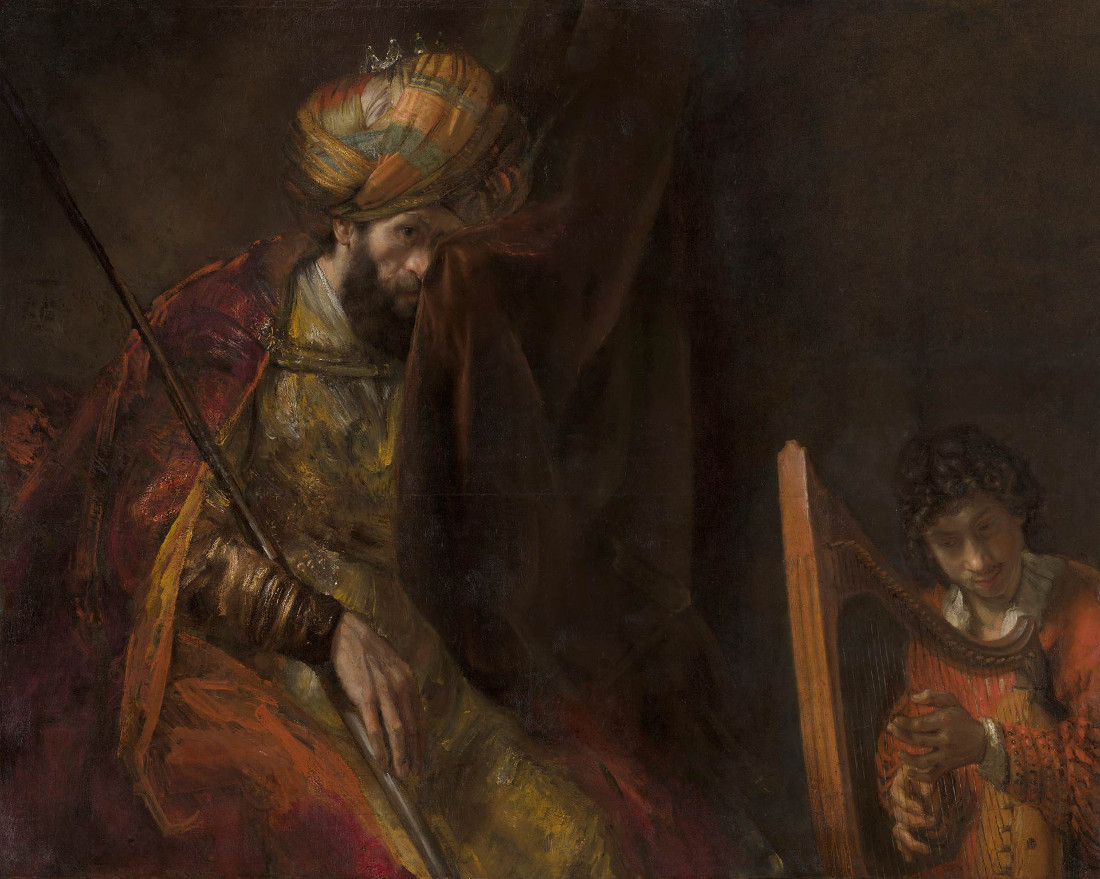 In reading this chapter on David, I was quick to want to look at Rembrandt’s Saul and David. As with any Rembrandt, the lighting tells the story. My eyes were drawn immediately to the crown upon Saul’s head. Saul is wiping away tears. He has a thousand yard stare, his shoulders slumped under the weight of royal garb, scepter or spear dropped. He is a broken man. The weight of the crown is too much.
Following the lines of the Saul’s body, his right arm, the angle of the harp and the secondary lighting source, my eyes are moved to David. He too is appears to be gazing somewhere else. But his fingers are active and his mind engaged. His head is slightly cocked as if his mental state is of deep concentration…or to borrow a sport cliché, he is in the zone. Interestingly, my lines around David do not guide me to his face, but to his chest, or more specifically, to his heart.
The movement of the painting is from the crushing weight of Saul’s crown through his complete dejection to David’s heart and his soulful playing of the harp. It is the transfer of Kingly authority.
The beauty of this painting is how Rembrandt has captured the ethos of the I Samuel passage. In chapter 15 Saul has not fulfilled the Lord’s specific command to destroy the Amalekites. He has tried to reason and rationalize his choices, but it was a blatant disregard of God’s command. Samuel is called to break the news to Saul that it is over for him as King…and in the process to “hack Agag (the Amalekite king) to pieces” I Sam. 15:33 (I only wish I knew the Hebrew phrase…I guess I’ll have to wait until Hebrew I this January). The Spirit of the Lord leaves Saul in chapter 16 and an evil spirit comes upon him. This spirit is only soothed by the playing of a skilled musician. Enter David. David’s skillful playing gives Saul relief of the evil spirit. It must weigh on Saul’s heart heavily, however, that the days of his reign are numbered and God will raise up another King. This will be a king who understands Samuel’s words in I Samuel 15:22-23:
“Has the Lord as great delight in burnt
Offerings and sacrifices,
As in obeying the voice of the Lord?
Behold, to obey is better than sacrifice,
And to listen than the fat of rams.
For rebellion is as the sin of divination,
And presumption is as iniquity and
Idolatry.
Because you have rejected the word of The Lord,
He has rejected you from being king.”
I think Rembrandt captures that the weight of the crown of Israel is going to be transferred to one whose heart is attuned to God. David was a man after God’s own heart. He is playing as one who is not thinking about music, but as one who is allowing the music to flow from his heart. Immediately preceding the Spirit of the Lord leaving Saul, David is anointed by Samuel and the Spirit of the Lord comes upon him. In an artist’s way, this is what Rembrandt is capturing. It is breath-taking.
The weight of being King was transferred from Saul to David, but David was not the ultimate King for which God's people longed. There would be another greater King. Rembrandt's work is breath-taking, but what is more breath-taking to me is that David was only a shadow of the King to come. The one to come would not just be a "man after God's own heart" but he would share God's heart.
Tuesday, September 30, 2008
The Financial Crisis
I am in no way an economist. I studied History and Religion in college. I avoided business classes. I am, however, learning to become a good steward of the resources God has given. I believe in order to do this best, I need to understand my human nature and learn to make wise decisions, not emotional decisions. This, incidentally, is one of the keys to Warren Buffett's financial decision making process (and I think he's doing just fine).
In thinking about the current financial crisis I have come up with two words that summarize the whole mess: Fear and Greed.
 Our nation's current emotional gauge is pegged on "Scared Spitless." We watch the news daily cry out that the sky is falling. The talking heads tell us that soon we'll all be living in caves and foraging for nuts and berries just to survive. The vision in my head resembles Mad Max, Beyond Thunderdome. This stokes our fear. The important thing to remember is that the media is a business. Their job is to titillate or stoke fear. If the media tells you that everything is fine, nobody worry, it's going to be okay...you'll stop watching. If they can, however, stoke your fear, then you will watch more. If you watch more, they can sell more advertising. If they can sell more advertising, then THEIR financial crisis is averted. Ironically, that advertising also plays into the other key word of this Financial Crisis, Greed.
 Yes, corporate America is greedy. Banks and financial institutions really screwed up. Their greed is putting the financial solvency of our country at risk. Many people will loose fortunes and jobs. But the real problem is much closer to home than Wall Street. Their greed was only possible because of our greed. Main Street is far more responsible for this than Wall Street.
As you're watching the coming of the Apocolypse on TV, you see an ad for that new thing. You know that thing, the one that is new and better than the old thing. It has been completely redesigned and improved. This thing will do what no other thing has ever done...and it's cooler than the other things. The people at your office will be envious of your new thing. The ladies at your Bible study will want one, too. You'll be a happier person with this new thing. Life will be better with this thing. Skies will be bluer. Grass will be greener. Your wife will be prettier. Your hair will be fuller. You can run faster and jump higher. You'll look 10 years younger. You will be a better person. You MUST have this thing.
The truth is, this thing is crap. You don't need it. You don't even really want it, but some genius twenty eight year old ad wizard has learned how to manipulate your basest instincts so that you think this new thing is salvation in a bottle. So you buy the new thing. It could be dinner out, a new flat screen tv, an iPhone, a hybrid SUV, that bigger house or the perfect vacation. You don't have to money to buy it, so you charge it, mortgage it or refinance it. Then Wall Street has offered to fulfill desires with a Faustian pledge. You can have whatever you want, TODAY! We all want to think we're smarter than this, but the truth is, we've all succumbed to it. We're all part of the problem because we all look for someTHING to fill the need in our life that only someONE could fill.
So what do we do? How do we respond sensibly and wisely to this situation? I propose that there are four responses that the average Christian can make.
First, we need to pray for our leaders and for whoever is going to be our leaders in the coming years. They will need to make difficult decisions about this situation. God is not worried, surprised, or afraid of this situation. He is the one who ones a thousand cattle on the hills (Ps 50:10). A thousand cattle may not sound impressive, but contextually it meant God owns everything.
Secondly, get your own house in order. Eliminate debt. Use a budget. Spend responsibly. Get rid of the stuff that is choking your life.
Thirdly, care for your neighbors. How is the family next door dealing with this issue? How can you offer them hope that extends beyond the current crisis? What can you do to help them today? Pray for them and let them know you are doing so. Be involved in their lives.
Fourthly, work for a solution to the current situation. Your vote will speak powerfully. There are lots of people in Congress nervous about November. They don't want to lose their job over this issue. There is a presidential battle that will be decided by a slim margin. Let it be known that you will vote for the candidate seeks to wisely solve this problem. What works for your house will work for the government. Avoid debt. Spend wisely. Get rid of things that choke the life out of our econonmy.
Again, I re-emphasize that I am not an economist, but in looking over alternatives to the $700 Billion bailout plan, I came across one proposed by Dave Ramsey. It makes sense at a basic level (another key to Warren Buffett's investment strategy). You can read it here.
In thinking about the current financial crisis I have come up with two words that summarize the whole mess: Fear and Greed.
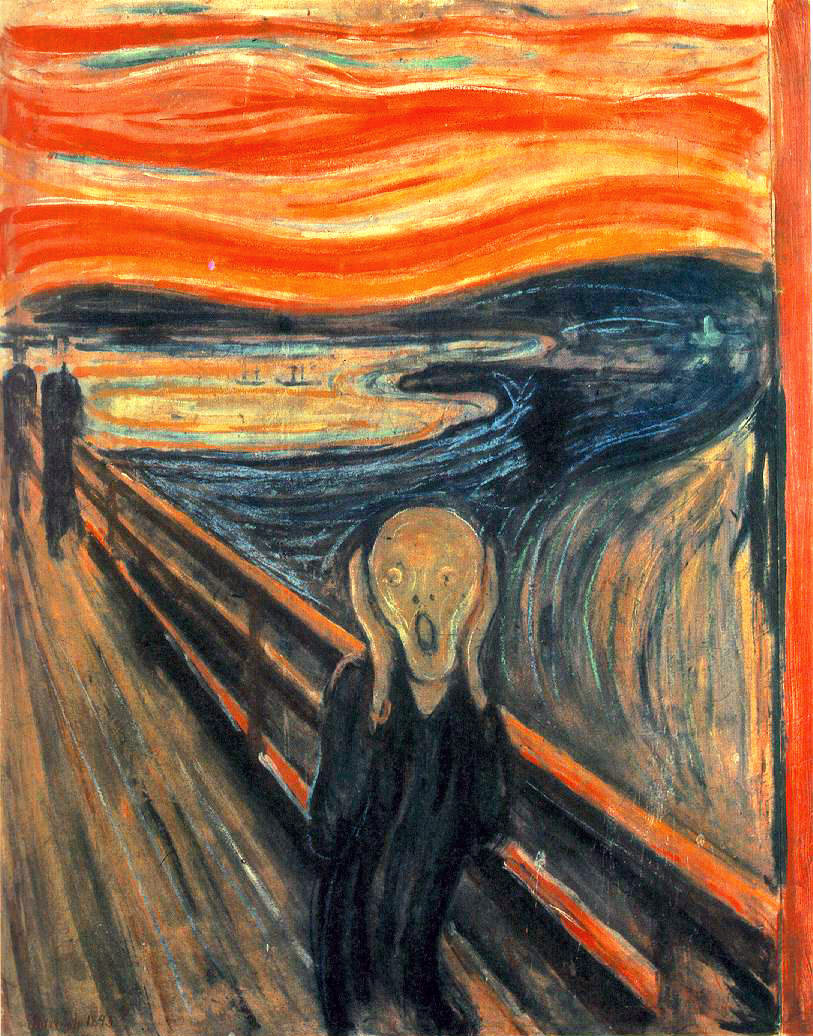 Our nation's current emotional gauge is pegged on "Scared Spitless." We watch the news daily cry out that the sky is falling. The talking heads tell us that soon we'll all be living in caves and foraging for nuts and berries just to survive. The vision in my head resembles Mad Max, Beyond Thunderdome. This stokes our fear. The important thing to remember is that the media is a business. Their job is to titillate or stoke fear. If the media tells you that everything is fine, nobody worry, it's going to be okay...you'll stop watching. If they can, however, stoke your fear, then you will watch more. If you watch more, they can sell more advertising. If they can sell more advertising, then THEIR financial crisis is averted. Ironically, that advertising also plays into the other key word of this Financial Crisis, Greed.
 Yes, corporate America is greedy. Banks and financial institutions really screwed up. Their greed is putting the financial solvency of our country at risk. Many people will loose fortunes and jobs. But the real problem is much closer to home than Wall Street. Their greed was only possible because of our greed. Main Street is far more responsible for this than Wall Street.
As you're watching the coming of the Apocolypse on TV, you see an ad for that new thing. You know that thing, the one that is new and better than the old thing. It has been completely redesigned and improved. This thing will do what no other thing has ever done...and it's cooler than the other things. The people at your office will be envious of your new thing. The ladies at your Bible study will want one, too. You'll be a happier person with this new thing. Life will be better with this thing. Skies will be bluer. Grass will be greener. Your wife will be prettier. Your hair will be fuller. You can run faster and jump higher. You'll look 10 years younger. You will be a better person. You MUST have this thing.
The truth is, this thing is crap. You don't need it. You don't even really want it, but some genius twenty eight year old ad wizard has learned how to manipulate your basest instincts so that you think this new thing is salvation in a bottle. So you buy the new thing. It could be dinner out, a new flat screen tv, an iPhone, a hybrid SUV, that bigger house or the perfect vacation. You don't have to money to buy it, so you charge it, mortgage it or refinance it. Then Wall Street has offered to fulfill desires with a Faustian pledge. You can have whatever you want, TODAY! We all want to think we're smarter than this, but the truth is, we've all succumbed to it. We're all part of the problem because we all look for someTHING to fill the need in our life that only someONE could fill.
So what do we do? How do we respond sensibly and wisely to this situation? I propose that there are four responses that the average Christian can make.
First, we need to pray for our leaders and for whoever is going to be our leaders in the coming years. They will need to make difficult decisions about this situation. God is not worried, surprised, or afraid of this situation. He is the one who ones a thousand cattle on the hills (Ps 50:10). A thousand cattle may not sound impressive, but contextually it meant God owns everything.
Secondly, get your own house in order. Eliminate debt. Use a budget. Spend responsibly. Get rid of the stuff that is choking your life.
Thirdly, care for your neighbors. How is the family next door dealing with this issue? How can you offer them hope that extends beyond the current crisis? What can you do to help them today? Pray for them and let them know you are doing so. Be involved in their lives.
Fourthly, work for a solution to the current situation. Your vote will speak powerfully. There are lots of people in Congress nervous about November. They don't want to lose their job over this issue. There is a presidential battle that will be decided by a slim margin. Let it be known that you will vote for the candidate seeks to wisely solve this problem. What works for your house will work for the government. Avoid debt. Spend wisely. Get rid of things that choke the life out of our econonmy.
Again, I re-emphasize that I am not an economist, but in looking over alternatives to the $700 Billion bailout plan, I came across one proposed by Dave Ramsey. It makes sense at a basic level (another key to Warren Buffett's investment strategy). You can read it here.
Saturday, September 27, 2008
Great Quote From Reggie Kidd's Book
 Reggie Kidd teaches my Intro to Pastoral and Theological Studies class. He wrote a book about worship and its connection to our heart and our theology...at least that's what I've gotten out of it so far. If you enjoy music and theology, then go to his website and pick up a copy...and send him an email telling him that I told you to...you never know what will help that grade go from a B to an A...
The quote is from Bono (of U2). In addition to being the authority on all things hip and cool, he's a pretty deep thinker. Bono said, "Music is Worship; whether it's worship of women or their designer, the world or its destroyer,...whether the prayers are on fire with a dumb rage or dove-like desire...the smoke goes upwards...to God or something you replace God with...usually yourself." -Bono, Introduction to Selections, x, xi.
Intro to My Fake Sermon
One of the classes I am taking is Communications I. It is essentially a Preaching class. Part of the class is working through the process of crafting a good Christ-centered sermon. I was assigned to preach on Philippians 2:1-11 (click on the passage to read it). Basically, I'm preparing a fake sermon. The only guys who hear it are the four other guys in my small group...and sometimes my Comm. professor, Larry Kirk (but that's only because my voice tends to carry in small rooms).
So, I thought it might be interesting to share with anyone who might be reading the intro to my fake sermon.
My family and I decided to do something that I vowed never to do. We decided to go to Disneyworld. Now, it wasn’t that I was opposed to going to Disneyworld. I love Disneyworld, it’s the happiest place on earth, or so they say. The issue was that we decided to go to Disneyworld on one of those hot, muggy, humid, I live in a Florida swamp summer days. It was also a Saturday, which meant that every tourist from St. Louis to Shanghai was going to be there. It was blazing hot and incredibly crowded. It was not what I would describe as joyful. Now, the novelty of Disneyworld usually trumps the heat and crowds, but this particular year we had been given annual passes to Disney. We had already been dozens of times that year. The novelty of a six foot talking mouse had worn off on me.
I was pounding the pavement pushing our double stroller with our two kids and working through the bitterness in my heart about swimming upstream through the masses of humanity to get to all rides so that I could spend a majority of my day waiting to ride on a ride that lasts a minute and half. We got to the “Small World” ride. It is an absolute Disney classic, complete with animatronic dolls from every continent singing in their native language, “It’s a small world…” It’s cute the first time the song plays, but then it repeats, again and again. Around the seventh time I’m struggling with really violent thoughts about baseball bats and the German doll in lederhosen. I believe I have painted a completely joyless picture of my time at Disneyworld.
Then I look at my kids. They are wide-eyed and amazed. They are singing along. They are pointing and laughing. At that moment, there is nothing greater than what they experiencing. I was so set on my own experience, my own feelings, my own rights, my own self that I was missing the reward of being at the Happiest Place on Earth with my kids. My lack of humility robbed me of the joy I could have had by joining with my children in their wonder at this ride.
We all struggle with a lack of joy at times because selfishness robs us of the unity with others. Often our humility is pushed aside so that we can exercise our own rights. We miss the reward of the joy of unity with other believers because we find it difficult to consider them above ourselves.
The apostle Paul addresses a similar issue, though under drastically different circumstances. The church at Philippi was struggling with selfishness and dissention internally and externally and this was robbing it of the joy of living in Christ. In the 2nd chapter of Philippians, verses 1 through 11, Paul shows that humility is a key to the joyful life because humility was Christ’s path to the Father.
So, I thought it might be interesting to share with anyone who might be reading the intro to my fake sermon.
My family and I decided to do something that I vowed never to do. We decided to go to Disneyworld. Now, it wasn’t that I was opposed to going to Disneyworld. I love Disneyworld, it’s the happiest place on earth, or so they say. The issue was that we decided to go to Disneyworld on one of those hot, muggy, humid, I live in a Florida swamp summer days. It was also a Saturday, which meant that every tourist from St. Louis to Shanghai was going to be there. It was blazing hot and incredibly crowded. It was not what I would describe as joyful. Now, the novelty of Disneyworld usually trumps the heat and crowds, but this particular year we had been given annual passes to Disney. We had already been dozens of times that year. The novelty of a six foot talking mouse had worn off on me.
I was pounding the pavement pushing our double stroller with our two kids and working through the bitterness in my heart about swimming upstream through the masses of humanity to get to all rides so that I could spend a majority of my day waiting to ride on a ride that lasts a minute and half. We got to the “Small World” ride. It is an absolute Disney classic, complete with animatronic dolls from every continent singing in their native language, “It’s a small world…” It’s cute the first time the song plays, but then it repeats, again and again. Around the seventh time I’m struggling with really violent thoughts about baseball bats and the German doll in lederhosen. I believe I have painted a completely joyless picture of my time at Disneyworld.
Then I look at my kids. They are wide-eyed and amazed. They are singing along. They are pointing and laughing. At that moment, there is nothing greater than what they experiencing. I was so set on my own experience, my own feelings, my own rights, my own self that I was missing the reward of being at the Happiest Place on Earth with my kids. My lack of humility robbed me of the joy I could have had by joining with my children in their wonder at this ride.
We all struggle with a lack of joy at times because selfishness robs us of the unity with others. Often our humility is pushed aside so that we can exercise our own rights. We miss the reward of the joy of unity with other believers because we find it difficult to consider them above ourselves.
The apostle Paul addresses a similar issue, though under drastically different circumstances. The church at Philippi was struggling with selfishness and dissention internally and externally and this was robbing it of the joy of living in Christ. In the 2nd chapter of Philippians, verses 1 through 11, Paul shows that humility is a key to the joyful life because humility was Christ’s path to the Father.
Wednesday, September 17, 2008
Chapel 9.17.08
Who is God? There are all sorts of answers to this question. We all live for God (or more specifically a god), even atheists. The question is not whether one lives for God, but who or what that God is. I really appreciated Dr. Swain's three questions to help define who I viewed as God. He developed his chapel message from II Cor. 5:14-15
14For the love of Christ controls us, because we have concluded this: that one has died for all, therefore all have died; 15and he died for all, that those who live might no longer live for themselves but for him who for their sake died and was raised.
In verse 15 he explained how the love of Christ allows those who live to no longer live for themselves, but for Christ. What does it mean that they lived for themselves? Dr. Swain's three questions brought this question to light:
1. In whose strength do I rely on?
2. Whose rules do I follow?
3. Whose glory do I seek?
When I ran my life through the grid of those questions, I saw that in so many ways my god is me. In so many ways I live for myself.
This is a humbling thought.
It was really brought home later in the day during my Evangelism class. Dr. Childers had us look at three motives for evangelism. The first motive is that God commands us. It pretty simple, the Bible is very clear that we are to share Christ. The second motive is that we have a compassion for the lost. We need to have a broken heart for the lost and see them as God sees them. These first two motives are legitimate, but insufficient. The third motive is the most important. The third motive is zeal for God and His glory. That's when it clicked for me. I have zeal for a god and his glory.
In whose strength do I rely on - Me
Whose rules do I follow - Me
Whose glory do I seek - Me
My evangelism is weak because my motive is not a zeal for God and His glory, but a zeal for me and my glory. May I be controlled by Christ, that I may live no longer for myself but for him.
What about you? Who is your God? What motivates you to share your faith?
14For the love of Christ controls us, because we have concluded this: that one has died for all, therefore all have died; 15and he died for all, that those who live might no longer live for themselves but for him who for their sake died and was raised.
In verse 15 he explained how the love of Christ allows those who live to no longer live for themselves, but for Christ. What does it mean that they lived for themselves? Dr. Swain's three questions brought this question to light:
1. In whose strength do I rely on?
2. Whose rules do I follow?
3. Whose glory do I seek?
When I ran my life through the grid of those questions, I saw that in so many ways my god is me. In so many ways I live for myself.
This is a humbling thought.
It was really brought home later in the day during my Evangelism class. Dr. Childers had us look at three motives for evangelism. The first motive is that God commands us. It pretty simple, the Bible is very clear that we are to share Christ. The second motive is that we have a compassion for the lost. We need to have a broken heart for the lost and see them as God sees them. These first two motives are legitimate, but insufficient. The third motive is the most important. The third motive is zeal for God and His glory. That's when it clicked for me. I have zeal for a god and his glory.
In whose strength do I rely on - Me
Whose rules do I follow - Me
Whose glory do I seek - Me
My evangelism is weak because my motive is not a zeal for God and His glory, but a zeal for me and my glory. May I be controlled by Christ, that I may live no longer for myself but for him.
What about you? Who is your God? What motivates you to share your faith?
Subscribe to:
Posts (Atom)